Aquiva blog/Agentforce
Salesforce Agentforce Pricing (2026): Flex Credits, Conversations, and Editions
On May 15, 2025, Salesforce announced the major pricing revamp for Agentforce, which allows businesses of all sizes to leverage AI agents without burning their budgets. The old pricing model $2 per conversation, faced backlash for being pricey and unpredictable for small and mid-sized businesses. There were a lot of questions regarding...
On May 15, 2025, Salesforce announced the major pricing revamp for Agentforce, which allows businesses of all sizes to leverage AI agents without burning their budgets. The old pricing model $2 per conversation, faced backlash for being pricey and unpredictable for small and mid-sized businesses.
There were a lot of questions regarding what the conversation meant and how users are charged. Considering this, Salesforce introduced a new pricing model while keeping the older one as an option.
The new model, called Flex Credits offers the same features but it has introduced the credit system this time. So, instead of paying for each action, you’ll pay it as a one-off.
In this blog, I’ll talk about the Agentforce pricing update, what the new pricing model is, how the new credit system works, and other essential add-ons.
Since Dreamforce 2025, Salesforce brands the platform as Agentforce 360. The name changed; the pricing mechanics below didn’t.
Agentforce’s new flex credit plan is tied to a minimum of 100k credits for $500. This is a consumption-based model where businesses only pay for the exact actions that Agentforce performs.
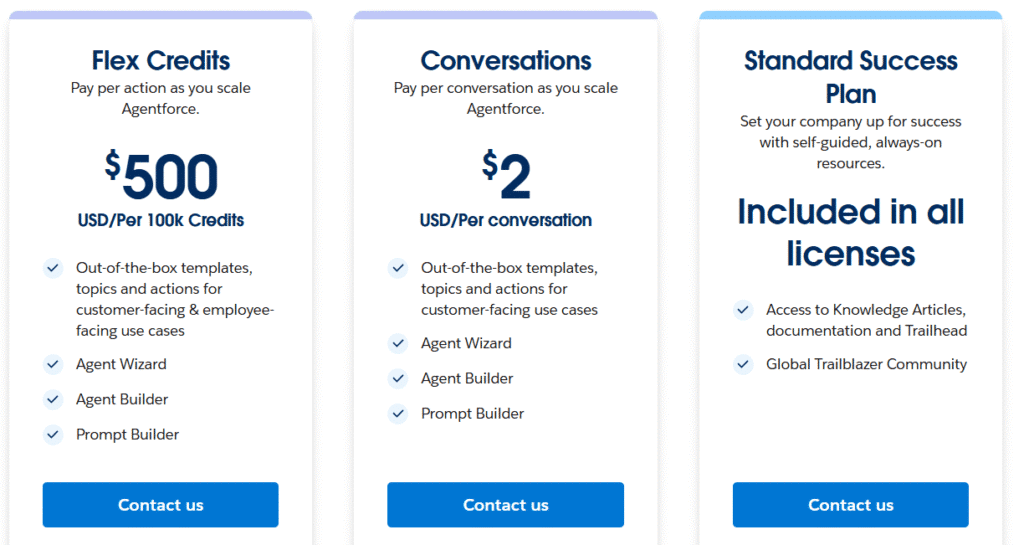
Each of these actions consumes 20 flex credits ($0.10 per action). Voice actions cost 30 credits ($0.15). Both rates come from Salesforce’s Flex Credits Rate Card, updated April 21, 2026. Each AI agent’s actions are the functions that the AI executes such as updating a record, summarising a complex case, answering a product enquiry, or executing a custom prompt or flow.
You can manage all this in the Digital Wallet, which tracks usage in real time across orgs, agents, and teams. Sandbox usage is discounted, and token limits help keep LLM costs in check.
With the 2025 Agentforce pricing update, Salesforce has introduced a set of innovations aimed at simplifying subscription management, increasing flexibility, and providing more predictable costs for businesses using AI-powered agents.
The update centers around three main elements that are reshaping the way businesses leverage Agentforce: Flex Credits, the New Flex Agreement, and Agentforce User Licenses and Add-ons.
Each of these addresses specific challenges in enterprise SaaS billing, user adoption, and resource allocation.
Flex Credits
As I have explained above, the new Flex credit system is a major change in the Agentforce pricing. This pay-per-action model is ideal for the variable use and includes Agent Wizard, Builder, Prompt Builder, and templates.
While the most common actions cost $0.10 per action, the complex ones cost more. So, if an agent performs 10,000 actions in a month, that would amount to $0.10*10,000= $1,000.
These credits can be allotted to any client-facing employee and must be used before the order end date. Salesforce permits no rollover.
Orgs on Enterprise Edition or above get 100,000 Flex Credits free through Salesforce Foundations.
New Flex Agreement
The new flex agreement allows organizations to manage both human and digital labor. Thus, businesses can convert the user licenses into Flex credits and vice versa.
This way, companies can shift the budget between human user licenses and Agentforce AI agents.
Editions (Available now)
Agentforce Add-ons ($125 per user/month): Licensed employees get unlimited Agentforce usage with role- and industry-specific templates, full predictive, generative and agentic AI, embedded Tableau Next analytics, and Prompt Builder for customised automation.
List price for Agentforce 1 Editions is $550 per user/month. Agentforce editions include everything in the add-ons, bundled cloud-specific features at lower total cost, 1 million Flex Credits per org annually for license-to-compute swaps, and Data Cloud access with 2.5 million Data Services Credits per year.
If you’re interested in swaps, talk to your AE.
Also Read: Agentforce Pricing for ISVs
These changes align well with the broader shift to outcome-based automation. If you’re exploring the future of agent design, have a look at Agentforce 2dx: Salesforce’s Next Leap in Autonomous AI.
| Agentforce Pricing Option | Cost | Key Details |
|---|---|---|
| Flex Credits (usage-based) | $500 per 100,000 credits (a standard action = 20 credits ≈ $0.10) | Pay-per-action model; ideal for variable use. Includes Agent Wizard, Builder, Prompt Builder, and templates. |
| Conversations (usage-based) | $2 per conversation | Pay-per-chat (a session of up to 24 hours); ideal for customer-facing bots. Includes templates, Wizard, Builder, and Prompt Builder. |
| Agentforce Add-On (Sales/Service Cloud) | $125 per user per month | Unlimited internal AI agent usage per employee. Integrates directly with Salesforce Sales, Service, or Field Service Cloud. |
| Agentforce Industries Add-On | $150 per user per month | Unlimited AI agents are tailored for Industry Clouds (e.g., Financial, Healthcare). Includes specialized AI capabilities for regulated environments. |
| Agentforce 1 Edition | From $550 per user per month | Enterprise bundle: unlimited internal usage. Includes 1M Flex Credits and 2.5M Data Cloud credits per year. |
Salesforce now has three models:
1. Pre-purchase Model
The Pre-purchase model allows businesses to buy a predetermined amount of Agentforce usage upfront for the entire contract term. This approach is ideal for organizations with predictable workloads or seasonal campaigns, as it provides maximum cost savings by locking in a set usage at a fixed price.
Usage draws down from the purchased balance, giving teams the flexibility to allocate AI agent resources where they are most needed. Pre-purchase ensures budgeting certainty, avoids unexpected billing surprises, and supports large-scale deployments.
2. Pay-as-you-go Model
The Pay-as-you-go model offers maximum flexibility for organizations that prefer not to commit upfront. Businesses can start using Agentforce immediately, paying only for the AI usage they consume each month.
Billing occurs in arrears, which means costs scale directly with actual consumption, making it ideal for teams with variable workloads or uncertain AI demand. This model reduces financial risk while allowing organizations to experiment with Agentforce capabilities before committing to a larger plan.
Pay-as-you-go supports agile deployments, incremental adoption, and precise cost control, helping businesses balance flexibility and operational efficiency without overpaying for unused resources.
3. Pre-commit Model
The Pre-commit model allows organizations to commit to a baseline level of Agentforce usage without making an upfront payment. This approach combines the predictability of a minimum commitment with the flexibility of usage-based billing.
Businesses are billed monthly in arrears, and a true-up adjustment at the end of the contract term ensures fairness if actual usage falls below the committed baseline. The more usage committed to, the more value organizations unlock, making it ideal for enterprises that want to secure favorable pricing while retaining flexibility.
The Pre-commit model became widely available in late 2025, positioning it as a scalable, cost-efficient option for businesses planning long-term AI adoption.
Also Read: Is Agentforce the New Low-Code?
Here’s how Salesforce Agentforce flex credits work:
Defining an Action
When using Flex Credits, customers are billed per Action, with each Action defined as up to 10,000 tokens (roughly 8,000 words or 22 pages).
Exceeding this token threshold in a single Action (standard or custom) results in multiple charges, e.g. processing 20,001 tokens equals three Actions.
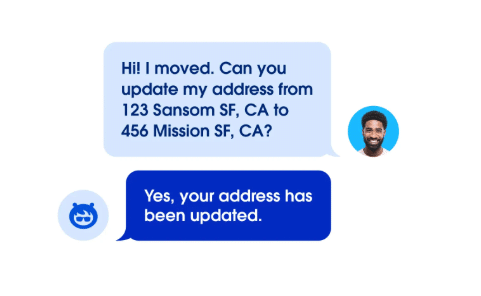
According to Salesforce, an action is a specific task that an AI agent performs to automate the user’s request. This includes updating customer records, troubleshooting actions, sending messages and more.
Standard vs. Custom Actions
Actions are triggered only when the agent performs work; pure dialogue without execution does not incur costs. Standard Actions are provided out-of-the-box, while Custom Actions include anything created or modified by the customer (or partner).
Both types are metered identically but may require licensing: some Standard Actions depend on Einstein for Sales or Service add-ons.
Sandbox and Bring Your Own LLM Usage
Additionally, sandbox usage consumes Flex Credits at 80% of the production rate (16 credits per standard action, 24 per voice action), and bringing your own LLM does not exempt customers from Flex Credit billing – they’re still charged for executed Actions and separately for their LLM provider usage.
Flex Credits vs. Einstein Requests
Einstein Requests are no longer used when Actions are executed through Agentforce agents under Flex Credits.
However, customers who invoke prompt templates outside of Agentforce (such as through Flow, Apex, LWC, or API) still consume Einstein Requests, not Flex Credits.
As of now, GenAI features that directly call AI models, such as Service Replies and Summarization, still consume Einstein Requesters.
Flex Credits vs. Conversations
Credits cannot be combined with Conversations; each org must choose one pricing model. Customers cannot run both Flex Credits and Conversations in the same org.
Overages, Expiration, and Entitlements
Overages are billed monthly in arrears at the agreed rate, and unused Credits expire at the end of the subscription term.
That said, we’re hearing that Credits can be pooled across contracts for flexibility. It’s also worth noting that not all Actions are universally available – some are gated behind specific Cloud or Industry licenses, which Salesforce will clarify over time (talk to your AE).
To avoid surprises, customers should proactively monitor usage via the Digital Wallet, configure overage alerts, and ensure their entitlements align with the Actions they intend to deploy.
Unlimited Usage for Internal Agents
For internal use cases – if you have the Agentforce Add-on or are on the Agentforce 1 edition, you get unlimited usage for employee agents. If you don’t, Flex Credits will be consumed per action as described above.
| Rule/Area | Details |
|---|---|
| Action Definition | 1 Action = up to 10,000 tokens (~8,000 words / 22 pages). |
| Exceeding Token Limit | >10,000 tokens in a single Action = multiple charges (e.g., 20,001 tokens = 3 Actions). |
| When Credits Apply | Only when the agent performs work (not pure dialogue). |
| Standard vs. Custom Actions | Both metered identically. Some Standard Actions may require additional licensing (e.g., Einstein for Sales/Service). |
| Sandbox Usage | Billed at 80% of the production rate (16 credits per standard action, 24 per voice). |
| Bring Your Own LLM | Still billed per Action + separate charges from LLM provider. |
| Einstein Requests | Not used when Actions run through Agentforce. Still apply for prompts outside Agentforce (Flow, Apex, LWC, API) or genAI features (Service Replies, Summarisation). |
| Pricing Models | Org must choose Flex Credits or Conversations—not both. |
| Overages & Expiration | Overages billed monthly in arrears. Unused Credits expire at the end of the subscription. |
| Pooling | Credits may be pooled across contracts (subject to Salesforce AE confirmation). |
| Entitlements | Some Actions gated by Cloud/Industry licenses—monitor via Digital Wallet. |
| Internal Agents | Unlimited usage if on Agentforce Add-On or Agentforce 1 edition; otherwise, Flex Credits consumed per Action. |
Agentforce pricing: quick answers
How much does Agentforce cost?
On the Flex Credits model, a standard action costs 20 credits, or $0.10 at the $500 per 100,000 credits list price. Voice actions cost 30 credits ($0.15). The alternative is $2 per conversation, and per-user options run $125 to $550 per user per month.
Is Agentforce still $2 per conversation?
Yes, as an option. The Conversations model charges $2 per conversation (a conversation window that runs up to 24 hours, depending on channel) and suits customer-facing bots with long interactions. An org picks one consumption model, Flex Credits or Conversations, never both. Break-even is about 20 actions per conversation: below that, Flex Credits cost less.
What does the Agentforce add-on cost per user?
$125 per user per month on Sales or Service Cloud, with unlimited internal agent usage for licensed employees. The Industries add-on is $150 per user per month for Industry Cloud environments.
What does Agentforce 1 Edition cost?
List price is $550 per user per month. It bundles unlimited internal usage, 1 million Flex Credits per org per year, and Data Cloud access with 2.5 million Data Services Credits.
This pricing overhaul makes Agentforce usable at scale. It’s rational, transparent and finally tied to real business value. Customers and technology partners have spent the past year trying to map strategy to a model that didn’t support how AI is actually deployed.
That’s changed now.
For CIOs, architects and commercial teams, Flex Credits create room to test, expand and deliver measurable ROI. For partners, they open a direct link between what’s built and what’s billed.
And for Salesforce, they lay the groundwork for more strategic adoption of digital labour, something the platform has been building towards, but until now lacked the commercial model to support.
Companies are no longer experimenting. They expect visibility, predictability and governance. Flex Credits provide that.
But they also raise questions: How secure is the data? What’s the carbon cost of scaled usage? How do we ensure compliance?
Need help estimating Salesforce Agentforce Flex Credit usage or designing a pricing model that delivers measurable ROI?
Or whether you want to know how to perform each action?
At Aquiva Labs, we’ve worked with Agentforce since its launch. Our projects span optimizing AI agent design, cost forecasting, and governance for enterprise customers.
If you’re an ISV sizing an AgentExchange opportunity, our Agentforce ROI Calculator models the three-year revenue impact of bringing an agent to market.
Book a call with our experts and discover how to use Agentforce with defined actions.