Aquiva blog/AI Strategy
How to Keep AI-Assisted Salesforce Development Cost-Effective
Two pricing announcements on the same effective date will reshape AI development costs. Architecture decisions made now define the AI expenses for the next two years.
Two announcements, one date
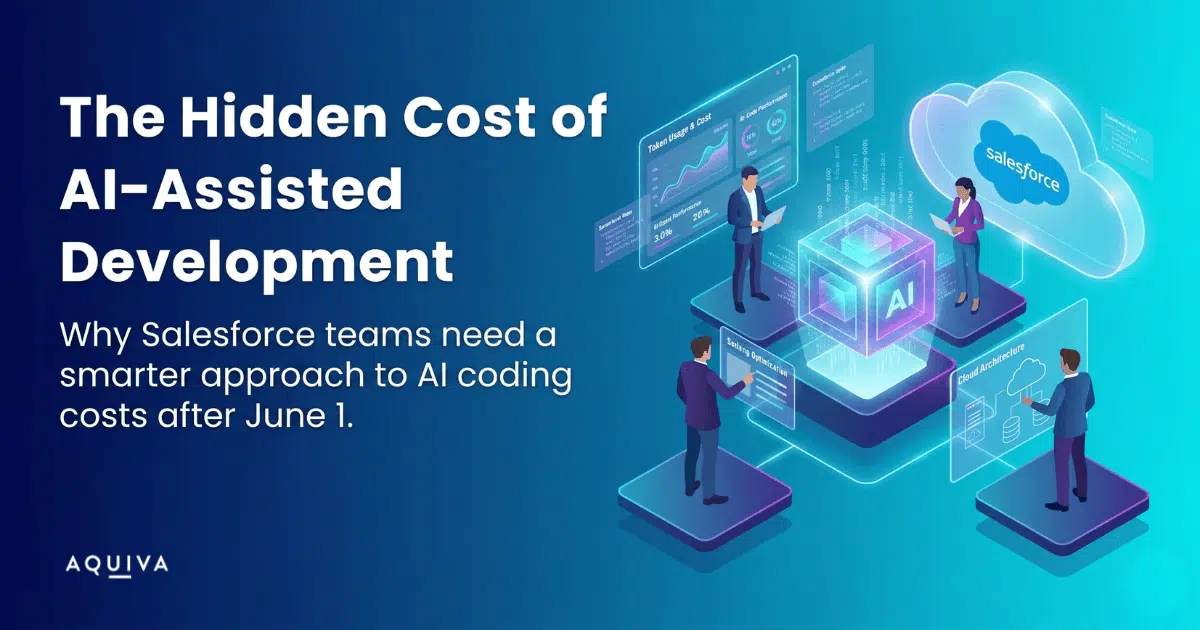
GitHub transitioned Copilot to usage-based billing on June 1, 2026, replacing Premium request units with GitHub AI Credits calculated by token consumption. Simultaneously, Salesforce ended free Agentforce Vibes access for non-Developer Edition organizations, requiring either Flex Credits or the new Agentforce 360 Platform license at approximately $125 per user monthly.
The window for effectively free AI-assisted development is closing permanently.
Why the pricing shift is rational
Modern coding agents execute extensive planning, generation, testing, and revision cycles consuming genuine compute resources. Rather than switching vendors — which only changes billing sources, not underlying economics — organizations must implement customer-side engineering improvements.
The default pattern that gets expensive fast
The costly default approach sends entire context repeatedly:
"Here is my whole context. Now help me."
Without optimization, Salesforce work becomes especially expensive due to distributed context across Apex, Flows, LWCs, custom objects, validation rules, permission sets, sharing rules, named credentials, and package metadata. Useful AI assistants need context but not every component at every turn.
The math
Internal benchmarks for typical complex Salesforce user stories:
| Metric | Unoptimized | Caching + RAG |
|---|---|---|
| Total tokens consumed | ~5M | ~5M |
| Input tokens at full price | 5M | 1M |
| Cached input tokens | 0 | 4M |
| Approximate cost per story | ~$25 | ~$3 |
A 10:1 ratio between fresh input and cached reads is standard across major providers. For a five-engineer team shipping ten AI-assisted stories weekly, unoptimized usage costs approximately $65,000 annually versus $7,800 properly architected — identical work, different prompts.
What actually drives the number
Two engineering disciplines create substantial cost reductions when implemented together:
Caching depends on exact prefix matching. Providers hash leading prompt bytes to locate cache hits. Any upstream character change invalidates downstream cache. Stable components (coding standards, package conventions, security rules, framework patterns) must occupy the prompt front in identical byte order, with variable components (user instructions, new files, test output) at the end. Anthropic's prompt cache survives roughly five minutes by default or up to one hour with extended settings.
Retrieval should follow dependencies, not keywords. Rather than dumping entire projects into prompts, dependency-aware retrieval pulls related services, schema, tests, and pricing patterns. Generic frameworks lack Salesforce-specific retrieval for metadata models, governor limits, packaging quirks, and Security Review constraints.
Two architectural moves that compound
Persistent memory and context. Most teams lose cache upon provider TTL expiration. Holding canonical context outside the provider's cache ensures subsequent session prefixes match exactly, triggering cache hits on essentially every turn after the first. Standards typically represent the largest invariant prompt block, so savings extend across workdays rather than single sprints.
Stable prefix sizing. The initial few thousand prompt tokens comprise deterministic standards (naming conventions, package boundaries, security patterns, target architecture) anchored at byte zero, never reordered. This returns cache hits on subsequent turns instead of cold-restarting, paying full input price once per session for standards instead of per turn.
A note on the flat-fee path
The $125-per-user-monthly option offers predictable costs, but flat-fee pricing doesn't eliminate architecture relevance. Today's unlimited SKU becomes tomorrow's tiered offering; Salesforce acknowledges pricing may change. Tooling generating rework, test failures, or architectural cleanup consumes margins saved on inference bills. Few organizations use single tools exclusively, and strategies depending on vendor pricing models lack durability.
Where we fit in
Aquiva Labs built AI-assisted development workflows over eighteen months for internal engineering and partner teams. Our engineering MCP and platform enable aggressive timelines without consuming margins to AI costs.
The critical question isn't which tool to select but which architecture to employ and its actual cost beyond June 1.