Aquiva blog/AI Strategy
Thinking About Replacing Salesforce With Your Own Vibe-Coded CRM? Read This First.
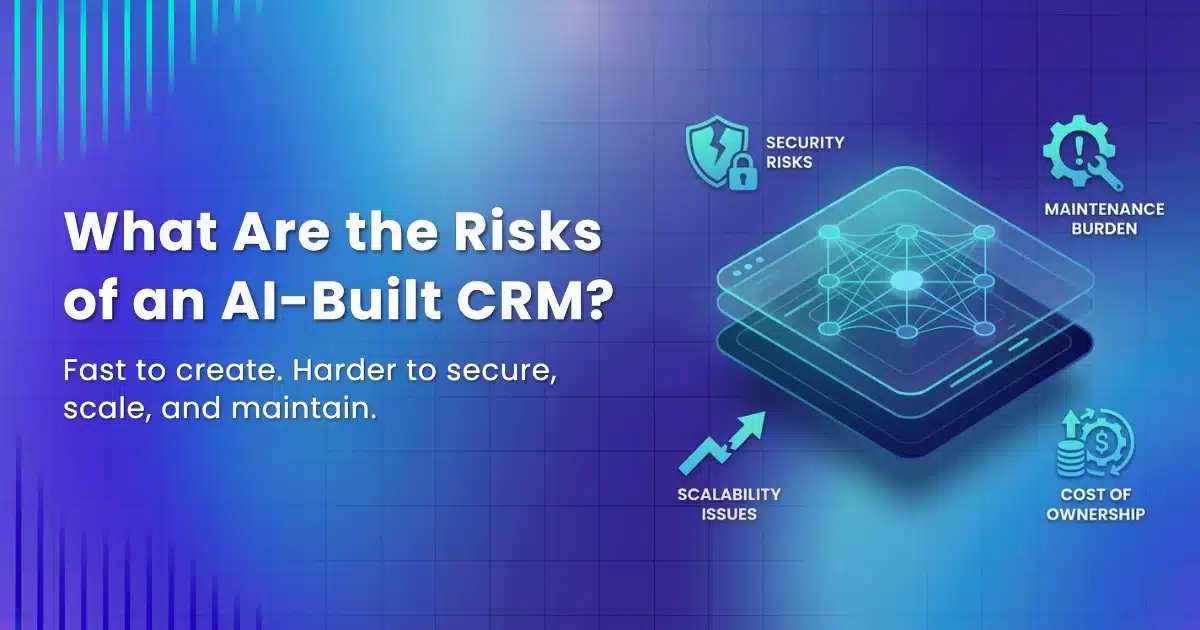
Fast to create. Harder to secure, scale, and maintain. Why "build your own CRM with AI" looks like a $300B savings on paper and a costly software business in practice.
| Renew Salesforce | Build an AI CRM from scratch | |
|---|---|---|
| Time to value | Your team is already trained. Data is clean. Processes are live. Value continues from day one. | Months of build, testing, and migration before anyone gets productive. A prototype is not the product. |
| Total cost of ownership | Known. Renewal fee plus your existing admin and dev costs. No surprises. | Low upfront, then grows with every feature request, bug fix, integration, and team change. |
| Scalability | Already handles your volume. Scales with Salesforce’s infrastructure investment, not yours. | Works at launch. Architectural limits appear when the business outgrows what was built. |
| Data & history | Years of customer data, pipeline history, and process logic are already in place. | Starts from zero. Migration is a project in itself, and data quality rarely survives it cleanly. |
| Maintenance burden | Salesforce maintains the platform. Your team focuses on configuration and business logic. | Your team owns everything: infrastructure, security patches, dependency updates, and incident response. |
| Vibe coding tool alone | AI-first Salesforce partner |
|---|---|
| “Great idea, let’s build it.” | “Have you thought about how this scales?” |
| Executes whatever you describe | Asks “Should we build this at all?” |
| No memory of what broke last time | Pattern-matched across dozens of orgs |
| Ships fast, no pushback | Asks the questions you forgot to ask |
| Done when the code runs | Done when the business outcome works |
| You own the consequences alone | Shared accountability, start to finish |
$300 billion gone in a day. So… is SaaS dead?
Earlier this year, Anthropic released Claude Code and a wave of AI development tools landed alongside it. Investors immediately questioned whether persistent SaaS subscriptions made sense if AI could build working applications in hours. The resulting market cap loss triggered conversations about a "SaaSpocalypse."
The reasoning sounds straightforward: as AI coding capabilities advance rapidly, seat-based pricing tied to headcount looks fragile if AI agents displace workers. But that narrative oversimplifies reality.
The hype is based on something real
A meaningful shift exists and it warrants serious attention. AI has genuinely reduced software development costs. Prototyping accelerates. Internal automation becomes more accessible. Custom solutions that previously required months now deploy in days. That pressure on weak products, sluggish roadmaps, and overpriced vendors is real.
The leap from that truth to "every company will build proprietary core business systems" has no foundation. Replacing enterprise platforms like Salesforce, ServiceNow, and Workday with AI-generated tools oversimplifies the actual requirements.
The Klarna clarification. The most-cited example of "replacing Salesforce with AI" reveals a different story on closer inspection. Klarna's CEO clarified they didn't swap SaaS for LLMs. They consolidated fragmented data onto an internal infrastructure using Neo4j and Cursor, while keeping Slack (a Salesforce product). Notably, he explicitly discouraged other companies from following their path.
Your feed is not giving you the full picture
Developers and builders — naturally excited about AI's potential — dominate the conversation. They perceive AI tools as freedom and leverage. That is a skewed sample.
Most organizations view this differently. Social media conversations between technologists about theoretical possibilities don't represent mainstream business perspective. WordPress simplified launching websites; most companies still hired agencies.
Critical distinction. Capability access differs from willingness to use it. Willingness differs from accepting ownership of what you build. Most prefer the completed service over managing the underlying infrastructure.
Building is only the beginning. Owning is the hard part
Creation is one component. Ownership is everything else. AI accelerates building but doesn't eliminate accountability.
Fabien Cros, Chief Data and AI Officer at Ducker Carlisle, put it bluntly:
It's very easy to build something that is shiny, but those things don't run properly. They are vibe-coded. They are not on a proper IT infrastructure. They are not secure.
The instinct that compares renewal invoices against a theoretical custom build overlooks the crucial question: what does the picture look like two years after you own what you constructed?
Renew Salesforce vs. build an AI CRM from scratch
| Dimension | Renew Salesforce | Build an AI CRM from scratch |
|---|---|---|
| Time to value | Your team is already trained. Data stays clean. Processes run live. Value continues immediately. | Months pass during build, testing, and migration before productivity begins. A prototype is not a finished product. |
| Total cost of ownership | Known quantities. Renewal fee plus existing admin and development costs. No surprises. | Low initially, then expands with every feature request, bug fix, connection, and staffing change. |
| Scalability | Already manages your volume. Scales via Salesforce's infrastructure investment, not yours. | Functions at launch. Architectural limits appear when the business grows past what was built. |
| Data & history | Years of customer data, pipeline history, and process logic already in place. | Starts empty. Migration is its own project, and data quality rarely survives intact. |
| Maintenance burden | Salesforce maintains the platform. Your team focuses on configuration and business logic. | Your team owns everything: infrastructure, security patches, dependency upgrades, incident response. |
The renewal looks expensive because it's a single visible line. Building your own spreads across engineering months, migration risks, retraining, and ongoing maintenance — most invisible on a single invoice. That doesn't make it cheaper; it makes it harder to quantify.
Vibe coding tools will love every idea you have. That's not a feature
Vibe coding tools have an agreeable personality. They embrace your concepts.
Another feature? Sure. One more exception? Of course. Five workflows merged into one custom experience? Why not?
This feels great initially. It moves fast. It validates your thinking. Progress feels obvious.
But helpful isn't the same as wise.
Tools that endorse everything provide no product judgment. They don't challenge assumptions. They don't ask whether the process should be redesigned before more software is layered on top.
Good partners work differently. They are deliberately slow up front so you don't get stuck halfway through. They ask questions you didn't anticipate. Sometimes they tell you that your exciting idea is solving the wrong problem.
That friction is valuable. It's the difference between fast and right. Constant affirmation feels productive in week one. By week six, when outcomes don't match expectations, you'll wish someone had pressure-tested your assumptions.
A partner experienced across many Salesforce orgs brings more than velocity. They bring perspective and patterns. They know which shortcuts last and which ones you'll be unwinding inside a year. Prompts can't substitute for that.
The difference in practice
| Aspect | Vibe coding tool alone | AI-first Salesforce partner |
|---|---|---|
| Response | "Great idea, let's build it." | "Have you thought about how this scales?" |
| Approach | Executes whatever you describe | Asks "Should we build this at all?" |
| Context | No memory of what broke before | Pattern-matched across dozens of orgs |
| Delivery | Ships fast, no pushback | Asks the questions you missed |
| Completion | Done when code runs | Done when business outcomes work |
| Accountability | You own the consequences alone | Shared accountability throughout |
I use AI tools every day. But I know what I bring to the table
To be transparent: I build things with AI that previously required days. I use it constantly. I'm not abandoning it.
But I know what I contribute when I use these tools. As a Salesforce CTA, I've spent years thinking about architecture, security, data structures, and how systems scale or hand off. When I vibe-code, I'm not just prompting — I'm directing. I apply experience the tool lacks.
Most organizations don't have that internally. They shouldn't have to. Their job is to grow, serve customers, and close pipeline — not to become an accidental software company.
AI is a force multiplier. Use it with someone who will tell you no
Marc Benioff remarked during Salesforce's February 2026 Q4 earnings call, at the peak of the SaaSpocalypse narrative: "You've heard about the SaaSpocalypse? And it isn't our first. We've had a few of them." He has seen the pattern repeat. Cloud was supposed to eliminate software, then mobile, then open source. The platform persists.
AI doesn't diminish the value of experienced Salesforce partners. It accelerates them.
An AI-first partner now delivers in weeks what used to require months. They explore more options, validate faster, and iterate in previously impractical ways. But the thinking behind the work — architecture choices, process design, challenging assumptions, validation — comes from experience that prompts cannot generate.
As AI makes execution cheap, that experience becomes more valuable, not less. Someone still has to shape the solution and think past the demo to engineer something that runs in production.
The organizations that succeed won't be the ones who hastily coded their own platform. They'll combine AI velocity with real delivery expertise, sturdy platforms, and sound judgment.
AI builds almost anything.
Good partners build the right things well.