Aquiva blog/ISV / AppExchange
What Is a Salesforce PDO (Product Development Outsourcer)?
What a Salesforce PDO does, how PDOs differ from SIs, how the 2026 partner program ranks them, and when your ISV should hire one.
AgentExchange (formerly AppExchange) is where ISVs meet Salesforce customers, and getting an app listed there is rife with challenges: managed-package architecture, a strict security review, and three platform releases a year to keep up with. When it comes to getting a successful app to market as quickly as possible, who you partner with matters. A lot.
The right consultant will ensure that the process is as seamless as possible and will look out for your long-term success.
The Salesforce ecosystem is flooded with consultants of every type, all with different expertise, skill levels, and credentials.
So how do you choose the right consultant to partner with you in building your app? In this article, we’ll explore the different types of Salesforce consultants, what makes a Salesforce PDO stand out from the pack, and what you should look for when evaluating PDO partners.
What is a Salesforce PDO?
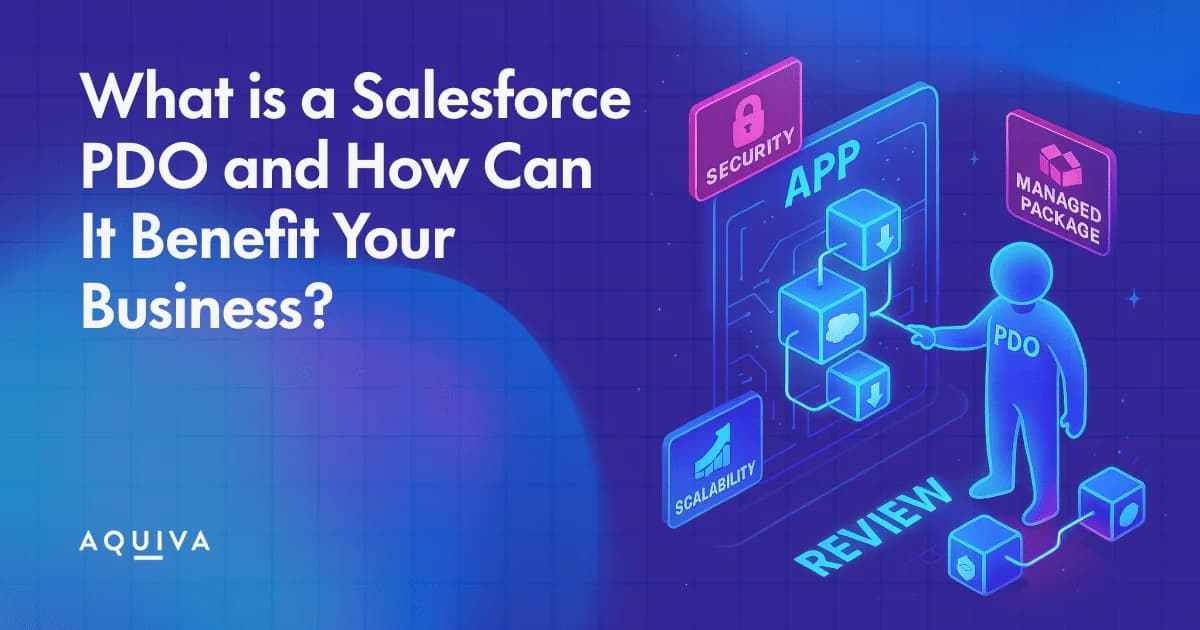
A Salesforce PDO, short for Product Development Outsourcer, is a Salesforce consulting partner with extensive experience building apps for AgentExchange.
A PDO helps independent software vendors (ISVs) with their product needs, building them a custom solution. PDOs offer more than just Salesforce development skills. They have the demonstrated knowledge and experience to architect scalable managed packages.
They also help ISVs avoid common security hazards that will hold up the security review.
Although a PDO is not necessary for all ISVs, it does make the process more seamless and ensures that the app gets to market as fast as possible. It also helps ISVs ensure that they build an app that solves the business problem it sets out to solve.
When should an ISV bring in a PDO?
Here are five specific instances where an ISV should consider bringing on a PDO to help with building their app for AgentExchange:
- A new startup building its MVP: An ISV that is building the first version of its package (MVP) and wants to get it right the first time can benefit from a PDO. The help of an experienced PDO enables new ISVs to build an app that users want to purchase, achieve the vendor’s business goals, and readily pass the Salesforce security review. The security review is especially stringent, so the oversight that a PDO gives is priceless.
- A quickly growing business: For ISVs experiencing rapid growth, a PDO partner can be extremely beneficial. When an existing ISV needs to quickly add new features, for example, a PDO can accelerate the company’s growth by providing an on-demand team of experienced developers and QA engineers.
- Early-stage, AppExchange-based startups: A solid in-house technical department is often lacking for young, AppExchange-based ISVs that are only a few years old. As a result, these ISVs can often have technical issues, like when it comes to processing large data volumes or adding new product features. A PDO provides a valuable partnership to help overcome this technical debt to ensure success.
- Businesses wanting to integrate new AppExchange tools and techniques: Even a successful ISV may have blind spots that are holding it back. An objective PDO with extensive experience and expertise is in the perfect place to help ISVs get the most from the Salesforce platform to grow their business.
- Mature stage challenges: It’s not only early-stage or growth-stage businesses that can benefit from partnering with a PDO. With business maturity comes new challenges, and a PDO is well-suited to help with those challenges. Managers who want to assess the actual situation of their products, for example, such as those who recently acquired a startup, can benefit from the expertise of a PDO.
PDO vs SI: what’s the difference?
In addition to PDOs, another type of Salesforce consultant that can help ISVs get their apps to market is System Integrators (SIs). While neither is better than the other, these two types of consultants each have their own distinctions that give them certain advantages depending on the needs of your business.
At a high level, the biggest difference between the two is their areas of specialization. PDOs’ expertise is in creating commercial apps. They are extremely product- and outcome-oriented and are comfortable dealing with ambiguity for ISVs that are not entirely certain about the app they want to build. They can guide ISVs through the product discovery process to help them create the app that will have the most success. They then continue to walk ISVs through delivery, helping strategize the best way to get in front of customers.
SIs, on the other hand, specialize in service expertise. They help organizations implement and configure their Salesforce org to meet their needs.
Key differences between PDOs and SIs include:
- SIs are project-oriented, while PDOs are product-oriented.
- SIs build the solution for one business process where management can enforce its use among users. A PDO on the other hand must build an engaging solution that will help users solve their problem, delivering end-user value that leads to product adoption.
- An SI project has a set start and end of development. While a PDO has a defined start, the relationship can continue throughout the lifecycle of the product.
- SIs may be familiar with the functionalities in Salesforce, but a PDO has additional expertise in ISV technology, such as Salesforce’s License Management App (LMA), Channel Order App (COA), and Feature Management App (FMA), to know what can actually be packaged.
How Salesforce ranks PDOs in 2026
To help ISVs pick a partner that best matches their needs, Salesforce ranks its consulting partners. For years, the instrument was the Navigator Program: Level I and Level II Navigator distinctions for demonstrated delivery, topped by Expert Navigator for the partners with the deepest track record, with specializations spanning the product lifecycle. That top designation is now called Cloud Expert PDO. Most PDO directories and partner listings you’ll find still speak the old language.
In 2026, Salesforce overhauled the partner program. The 170 legacy Navigator distinctions are being replaced by 28 core competencies, each with two recognition levels: Accredited for demonstrated capability, and Expert for scaled delivery excellence, measured on certifications, completed projects, and customer satisfaction. The old four-tier ladder collapsed into two tiers, Select and Summit. The details are still settling, but the practical read for an ISV evaluating partners hasn’t changed: look for the Expert level in the competency you’re buying, and a track record you can verify.
Why work with an Expert PDO
Finding the right PDO that can guide your organization through the app development process is critical for the overall success of your product. Working with a partner at the Expert level means that you have a PDO with solid experience and a track record of delivering projects with high customer satisfaction.
Working with a non-expert PDO or System Integrator partner can be a risk many ISVs are unwilling to take. It may mean that they simply haven’t had the chance to deliver on as many projects, but it could also mean that they don’t have a high level of consistent customer satisfaction or don’t have the qualifications and certificates to prove their expertise.
For those who lack the in-house skills or time to verify the quality of a PDO on their own, an Expert PDO is the safest option for a high-quality product and smooth process.
When it comes to the success of your project, an Expert PDO is essential. Compared with a SI, a PDO offers a deeper consultative relationship, helping you get a better product to market faster.
An Expert PDO can even potentially save you money with internal libraries, reusable models for building apps faster, and more so that you can act quicker and more efficiently.
Choosing an Expert PDO ensures that your Salesforce partner has the knowledge and experience to guide you effectively. Even veteran teams benefit from the unique expertise, gained by building Salesforce apps for many companies just like yours, that the right PDO provides. Aquiva has run this practice for ten years: we hold the Cloud Expert PDO designation and Select Partner status, and ISVs like RainFocus, BetterUp, Hapi, and Kaptio hired us to build the products their customers use.
Just like you wouldn’t hire a plumber to fix a leaky roof, hiring the right specialist to build your Salesforce app can mean the difference between app success and failure.
Salesforce PDO: quick answers
What does PDO stand for in Salesforce?
Product Development Outsourcer: a consulting partner that designs, builds, packages, and maintains commercial apps for ISVs on AgentExchange (formerly AppExchange).
What is the difference between a Salesforce PDO and an SI?
An SI (System Integrator) implements and configures Salesforce for one organization’s internal use, and the project has a defined end. A PDO builds commercial products that install into many customers’ orgs, which carries extra disciplines: managed packaging, upgrade safety, the security review, and ISV tooling like the LMA, COA, and FMA.
When does an ISV need a PDO?
When you’re building your first managed package, when growth outruns your in-house Salesforce team, or when a product needs rescue: technical debt, a failed security review, or an acquisition you need to assess. A simple internal tool doesn’t need one.
How do you evaluate a Salesforce PDO?
Under the 2026 partner program, look for Expert-level competency recognition and Select or Summit tier, then verify the track record: named customers, live AgentExchange listings, and security reviews passed. We keep a separate guide on choosing the right PDO partner.
Contact one of our specialists today or check out Aquiva’s AgentExchange listing to see how we can help make your project a success.