Aquiva blog/AI Strategy
Salesforce Einstein Trust Layer: AI Security & Compliance in 2026
Learn how Salesforce’s Einstein Trust Layer ensures AI security compliance with data masking, zero data retention, and auditability.
In early 2025, when the Chinese AI startup DeepSeek overtook ChatGPT on the Apple App Store, it made global headlines. The company’s R1 model matches OpenAI’s o1 in capability, runs locally, and is open source, all without a subscription fee.
While this democratization of AI is exciting, it also highlights a deeper issue that’s often overlooked: AI security compliance. As organizations rush to adopt generative AI tools, the pressure to balance innovation with data protection, governance, and transparency is growing rapidly.
For developers, AI is a playground of possibilities, flexible, fast, and affordable. But for CTOs and CISOs, it’s a potential risk surface. Every new AI system introduces questions around enterprise AI security, compliance obligations, and long-term accountability.
This widening gap between innovation and oversight has made trust the cornerstone of secure AI adoption. And few frameworks embody that better than the Salesforce Einstein Trust Layer, a system designed to ensure that the power of AI can be harnessed responsibly, without compromising privacy, compliance, or user trust.
The conversation around AI security compliance often depends on who you ask. A developer and a CTO can look at the same AI model and have completely different priorities, both valid, but shaped by their roles and responsibilities.
For developers, the focus usually lies on usability, affordability, and flexibility. If a model runs efficiently, integrates easily, and speeds up development cycles, that’s often enough. Compliance and governance matter, but they’re not always the deciding factors when choosing a model or API.
For CTOs, CISOs, and compliance leaders, the stakes are much higher. Enterprise AI security goes beyond functionality; it’s about protecting data, ensuring traceability, and maintaining compliance with evolving global standards like GDPR, HIPAA, or SOC 2. These leaders need visibility into how data flows through AI systems, who can access it, and whether it’s being retained or shared externally.
This contrast in priorities is precisely why structured frameworks like the Salesforce Einstein Trust Layer are critical. They bridge the gap between innovation and responsibility, giving developers the freedom to experiment while ensuring executives maintain governance and secure AI adoption at scale.
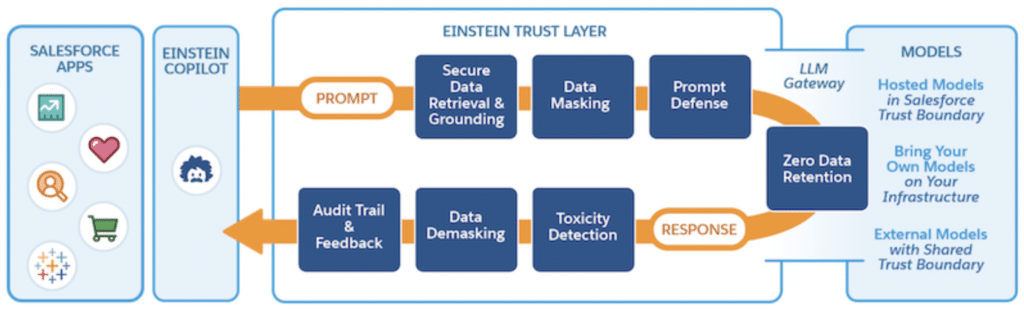
The Salesforce Einstein Trust Layer represents one of the most significant steps toward responsible and secure AI adoption in enterprise environments. It’s Salesforce’s framework for embedding AI security compliance directly into the platform’s core, ensuring that innovation doesn’t come at the cost of privacy or governance.
This trust framework safeguards sensitive business data while enabling teams to leverage generative AI capabilities confidently. It’s built to align with enterprise AI security principles and addresses key compliance challenges through multiple layers of protection:
-
Data Masking: Automatically identifies and hides sensitive data before it’s sent to large language models (LLMs), minimizing exposure.
-
Data Grounding with Secure Data Retrieval: Ensures AI responses are based only on data users have permission to access, preserving role-based controls.
-
Zero Data Retention Policy: Guarantees that customer data is never stored or reused by third-party AI models after processing.
-
Toxicity Scoring: Detects and filters inappropriate or harmful prompts and outputs before they reach the user.
-
Prompt Defense: Reduces hallucinations and helps maintain the integrity of generated content.
-
Auditability: Every AI interaction is logged for review, providing a transparent trail for compliance and regulatory reporting.
By combining these mechanisms, Salesforce has built a system where AI trust, transparency, and compliance coexist, giving organizations the assurance that their data, customers, and operations remain protected.
While the Salesforce Einstein Trust Layer is a major leap forward for AI security compliance, it’s not without its limitations. As with any emerging technology, the current framework continues to evolve, and organizations should be aware of these practical considerations before full-scale implementation.
1. Limited Data Masking Coverage
Data masking works well for identifying sensitive information, but coverage is enumerated, not universal: detection quality depends on the regions and languages in Salesforce’s support matrix. Check it against the languages your users actually write in.
2. Incomplete Toxicity Detection
Toxicity scoring is powerful but still language-dependent. Certain dialects and linguistic nuances may bypass detection, which can lead to inconsistencies in filtering harmful content.
3. Dependency on Data Quality
Dynamic grounding relies on your organization’s data to provide contextually accurate AI outputs. If your data is incomplete or outdated, the effectiveness of the grounding process, and thus the accuracy of AI responses, may decline.
4. Zero Data Retention Covers Providers, Not Your Org
Salesforce now enforces zero data retention with all of its external model providers. What the policy doesn’t cover is your own side: the audit trail stores prompts, responses, and trust signals in Data 360, and retention there is yours to govern.
5. Reliance on Data 360
Core features like audit logging and data grounding require Data 360 (formerly Data Cloud), which comes at an additional cost. This dependency could create budgetary or integration challenges for some teams.
6. Sandbox and Staging Limitations
Testing remains one of the more significant constraints. Most secure AI adoption features cannot be fully validated in staging or sandbox environments. For example, Data 360 features like audit logging or object grounding aren’t available for testing before deployment.
7. ISV and Packaging Restrictions
Currently, ISV partners cannot package or distribute the Einstein Trust Layer with their solutions. This restricts its availability for broader Salesforce ecosystem use.
Despite these challenges, the Einstein Trust Layer still sets a benchmark for what responsible AI should look like in enterprise environments, blending innovation with governance in a way that few competitors currently offer.
Einstein Trust Layer: quick answers
What is the Salesforce Einstein Trust Layer?
A security architecture built into the Salesforce platform that sits between your data and external AI models. It masks sensitive data before prompts leave Salesforce, grounds responses in data the user is allowed to see, scores outputs for toxicity, and logs every interaction for audit.
Is the Einstein Trust Layer included with Agentforce?
Yes. Every Agentforce agent action that calls an LLM routes through the Trust Layer. It kept its Einstein name through the Agentforce 360 rebrand.
Does Salesforce retain data sent to LLMs?
No. Salesforce enforces a zero data retention policy with its external model providers: prompts aren’t stored by the LLM, aren’t used for training, and aren’t reviewed by humans at the provider.
What are the Einstein Trust Layer’s limitations?
Masking coverage depends on the region and language support matrix, audit logging and grounding require Data 360 at additional cost, most features can’t be fully validated in a sandbox, and ISVs can’t package the Trust Layer into their own products.
As businesses race to integrate AI into their operations, the challenge isn’t just about performance; it’s about trust. The growing complexity of regulatory landscapes makes AI security compliance not a choice but a necessity for sustainable innovation.
While cost-efficient, high-performing models like DeepSeek or ChatGPT continue to dominate headlines, enterprise leaders know that true transformation comes from secure AI adoption, not just speed or accessibility. To build long-term credibility, organizations must adopt frameworks that prioritize enterprise AI security, transparency, and ethical governance.
That’s where systems like the Salesforce Einstein Trust Layer set an example. By enforcing zero data retention, granular auditability, and responsible prompt management, Salesforce proves that AI can be powerful without compromising data integrity or compliance.
At Aquiva Labs, we help Salesforce customers and ISV partners harness the power of AI securely. Whether it’s implementing the Einstein Trust Layer, building Agentforce applications, or developing an AI roadmap that aligns with your governance goals, we ensure every innovation remains compliant, reliable, and enterprise-ready. This work is the core of our Security, Risk and Compliance practice.
Ready to build AI you can trust?
Get in touch with Aquiva Labs to explore how we can help you adopt AI securely, scalably, and confidently.