Aquiva blog/Agentforce
What Is Agentforce?
Agentforce is Salesforce's platform for AI agents that plan and execute work in your CRM. What it is mechanically, what it isn't, what it costs, and where it breaks.
As of August 2026, Agentforce is Salesforce's platform for building AI agents: software that takes a request, plans a sequence of actions against your CRM data, executes them, and answers for the result. Salesforce announced it at Dreamforce in September 2024 as the successor to Einstein Copilot, and since Dreamforce 2025 the name covers the whole platform, branded Agentforce 360. An agent built on it can resolve a support case, qualify a lead, or process a return without a human driving each step.
If that still feels fuzzy, you're in good company: one of the top Google results for this question is a Reddit thread titled "I have no idea what Agentforce actually is." Salesforce's marketing doesn't help much, because phrases like "digital labor" describe what the company hopes agents will become rather than what the software does. We've been building on Agentforce since it shipped, so this post sticks to what the software does: how an agent is put together, what it costs, and where it breaks.
An agent is five decisions and a loop
When you build an Agentforce agent, you're really making five decisions: what job the agent has, what data it can see, what it's allowed to do, what it must never do, and where it talks to people, whether that's chat on your site, voice, Slack, or a panel inside a record page. Salesforce's vocabulary for these is role, data, actions, guardrails, and channel.
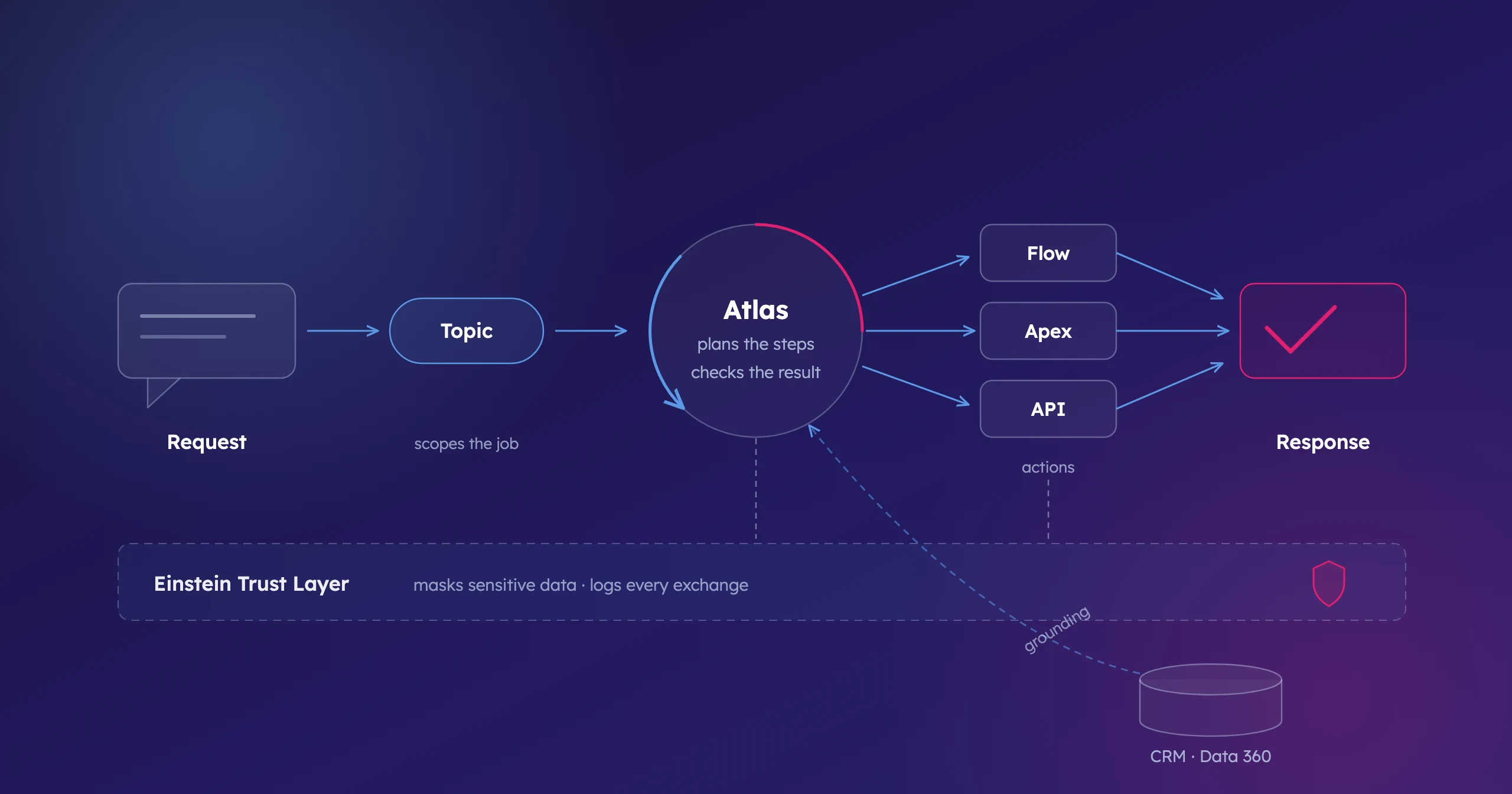
Underneath those decisions sit three building blocks. A topic scopes one job the agent handles, something like order inquiries or shipping status. Instructions are plain-language rules for how it should behave inside that topic. Actions are what it can actually do to your systems: invoke a flow, run Apex, call an external API, fill a prompt template, update a record. Building an agent mostly means writing these three things well, and then testing that they hold.
The part that ties them together is the Atlas Reasoning Engine, Salesforce's name for the planner. When a request comes in, it picks the topic, breaks the request into steps, chooses actions for each step, grounds itself in your CRM and Data 360 records along the way, and checks the result before responding. That loop is what separates an agent from a chatbot: instead of following a script, the agent decides which tools to call and in what order, and every one of those calls to a language model routes through the Einstein Trust Layer, which masks sensitive data before it leaves Salesforce and logs the exchange for audit.
What Agentforce is not
It isn't Einstein Copilot with a new sticker, although that's where it came from. Copilot was an assistant that suggested next steps for a human to carry out, and an Agentforce agent carries them out itself, within the guardrails you set. The lineage is short: Einstein Copilot became Agentforce at Dreamforce 2024, and the Einstein 1 Platform became Agentforce 360 at Dreamforce 2025. Confusingly, the Einstein Trust Layer kept its name through all of it, one of the few things that did.
It also isn't a general-purpose assistant, however much the demos suggest otherwise. An agent is only as capable as the actions you give it and only as accurate as the data you ground it in, so a team that skips the data work ends up with an agent that answers confidently from stale records, and no amount of prompt writing fixes that.
The afternoon-to-production story deserves the same caution. The demos where an agent springs to life in an hour are real, but they're demos: a production agent needs scoped topics, tested actions, and an eval and release discipline that looks a lot like normal software engineering, because that's what it is.
What it costs
You pay one of two ways: for consumption or for seats. On Flex Credits, a standard action costs 20 credits, which works out to about $0.10 at list price; the alternative is $2 per conversation, and per-user options run $125 to $550 per user per month. The mechanics have real edges worth understanding before you commit, and we keep a full breakdown current in our Agentforce pricing guide. ISVs have their own math, covered in Agentforce pricing for ISVs, and our ROI calculator models the revenue side of shipping an agent to AgentExchange.
What companies actually use it for
Most real deployments we see do one of four jobs. Customer-facing service agents resolve the routine share of cases and hand the rest to a human with a summary attached. Sales development agents take an inbound lead from first question to booked meeting. Internal employee agents answer the how-do-I and where-is questions that eat a workday, and they're where the per-user add-on's unlimited internal usage changes the economics. The fourth job is commercial: ISVs build agents and agent components to sell on AgentExchange, which is the work our PDO practice exists for; most of the partners on our wall are ISVs.
Where it breaks
The first surprise is usually cost. An action that processes more than 10,000 tokens bills as multiple actions, so a chatty agent that touches tools on every turn adds up faster than the back-of-napkin math said it would. The second is coverage: data masking in the Trust Layer depends on a region and language support matrix, and the audit trail requires Data 360, which costs extra. The quietest one is drift, because an agent that shipped without evals degrades as data and prompts change around it. And underneath all of this, an agent in production is an operational system; someone has to watch it, test it against Salesforce's three yearly releases, and own the run book, which is exactly the job managed services exist for.
None of this argues against the platform. It argues against treating it as a feature you switch on.
Quick answers
What is Agentforce in simple terms?
Salesforce's platform for AI agents: software that plans and executes multi-step work in your CRM, like resolving a case or qualifying a lead, using your data, within guardrails you define.
How does Agentforce work?
You define topics, instructions, and actions. The Atlas Reasoning Engine plans a sequence of actions for each request, grounds itself in your CRM and Data 360 data, and routes every model call through the Einstein Trust Layer for masking and audit.
What is the difference between Agentforce and Einstein Copilot?
Copilot suggested next steps for a human to carry out. Agentforce agents carry out the work themselves, within the guardrails you define. Copilot was folded into Agentforce at Dreamforce 2024.
What can Agentforce do?
Whatever its actions allow: resolve support cases, qualify and book leads, answer employee questions, update records, run flows, call external APIs. It can't do anything you haven't given it an action and data for.
How much does Agentforce cost?
Roughly $0.10 per standard action on Flex Credits, $2 per conversation as an alternative, or $125 to $550 per user per month for unlimited internal usage. Full current numbers are in our pricing guide.